BPC-157 and My Surgery Recovery: Interesting Observation
Four days after having a lipoma removed, I'm noticing surprisingly fast improvement in bruising, soreness, and overall recovery. Could BPC-157 be playing a role? Here's what I've observed.
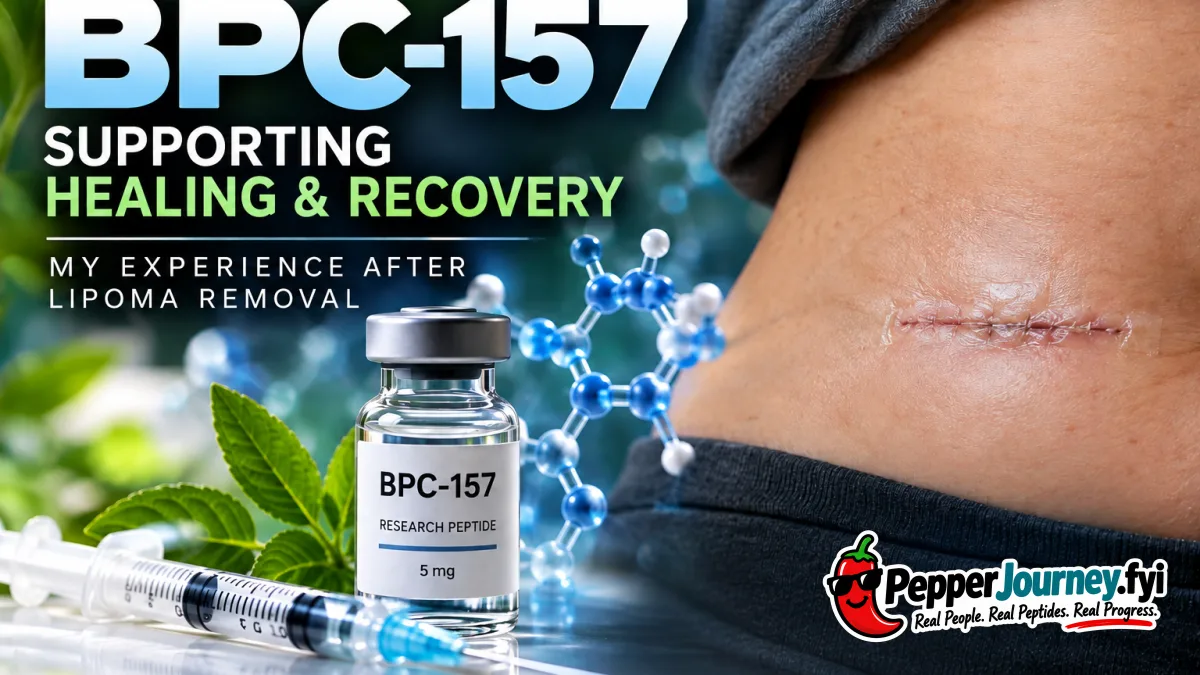
BPC-157 and My Surgery Recovery: Something Interesting Is Happening
I recently had a lipoma surgically removed from my abdomen. The incision was closed with stitches and surgical glue, and afterward, the area looked pretty rough.
Dark purple bruising, redness, soreness. All the usual post-surgery ugliness.
My doctor told me recovery could take a few weeks, which sounded pretty normal to me. I've had surgeries before, and I know healing takes time.
But this recovery has been a little different.
Where BPC-157 Comes Into the Picture
I've already been using BPC-157 as part of my personal peptide journey.
After the procedure, I decided to move my injection location to an area well below the surgical incision. I continued my usual daily injections.
I wasn't conducting an experiment. I wasn't measuring wound healing or doing anything particularly scientific.
But I was paying attention.
And what I've noticed has surprised me.
Day Four: Looking Better AND Feeling Better
Today is the fourth day after surgery.
The dark purple bruising has largely disappeared. The redness has faded, and the incision area looks dramatically better than it did immediately after the procedure.
But here's the part that really caught my attention.
**It feels better, too.**
The pain and soreness have decreased significantly. I'm not experiencing the level of tenderness and discomfort I would normally expect this soon after surgery.
And I've had surgeries before.
I know what recovery has typically felt like for me, and this one seems to be moving along much faster.
Now, is removing a lipoma the same as having a major abdominal surgery? Of course not. Different procedures mean different recovery experiences.
Still, the difference has been noticeable enough that I wanted to write about it.
Did BPC-157 Help?
That's the million-dollar question.
And my answer is simple:
**I think it's possible. But I can't prove it.**
BPC-157 has attracted interest for its potential tissue-repair properties, but research in humans remains limited. The FDA has also identified potential safety concerns involving compounded BPC-157. However, there isn't strong clinical evidence demonstrating that it speeds surgical wound healing in humans.
It's also an experimental, unapproved peptide, and its safety around surgery hasn't been established.
My improvement could be completely natural. It could be related to the type of surgery, the surgeon's technique, or any number of other factors.
But given my previous experiences with surgical recovery, I can't help wondering whether BPC-157 has contributed.
Why I'm Documenting This
Pepper Journey isn't a medical journal. It's my personal journal.
I share what I'm doing, what I'm experiencing, and what I notice along the way.
Sometimes the results are obvious. Sometimes they're disappointing. And sometimes something happens that makes me stop and think.
This is one of those moments.
I'm not recommending BPC-157 for surgical recovery, and I'm certainly not suggesting anyone inject experimental peptides near a fresh incision. That's something to discuss with a qualified medical professional.
I'm simply sharing an observation from my own experience.
**Four days after surgery, I look better, feel better, and seem to be recovering faster than I expected.**
Is BPC-157 responsible?
I don't know.
But I'm curious enough to keep watching.
I'll check back in as the healing continues.